


 Log in to your portal

When most people think about PPE, the image that springs to mind is usually a hard hat, goggles and maybe a big pair of good ole safety boots. But PPE (personal protective equipment) is a far broader concept than that, and more importantly, should never be thought of as the first line of defence.
PPE is meant to be the last line of defence, not the first. Yet many businesses still default to issuing kit before reviewing whether safer alternatives exist.
In this post, let’s take a practical look at when PPE should (and shouldn’t) be used, common pitfalls, and how employers can ensure PPE genuinely protects the people who rely on it.
Why PPE should be the “last line of defence”
Before issuing PPE, employers should assess whether other means of control can eliminate or reduce risk. This is reflected in the established Hierarchy of Control — a framework that prioritises safer and more effective hazard reduction methods ahead of PPE.
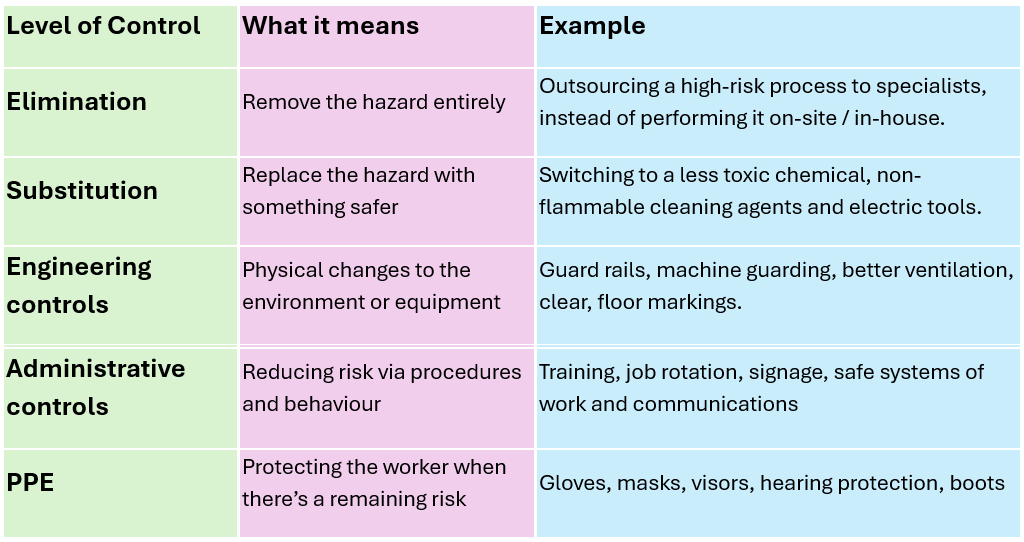
PPE doesn’t remove the danger — it simply reduces the harm caused if an incident occurs. That’s why PPE should only be introduced after all other reasonably practicable controls have been considered.
PPE is a much broader concept than many people think
The term PPE covers a wide range of products designed for different types of hazards:
- Head protection: hard hats, bump caps
- Eye & face protection: safety glasses, goggles, visors
- Hearing protection: ear defenders, earplugs
- Respiratory protection (RPE): disposable masks, half/full face respirators, powered air units and portable gas detection.
- Hand protection: cut-resistant, impact-resistant, heat, chemical or anti-vibration gloves
- Body protection: high-visibility clothing, coveralls, flame-retardant / arc flash clothing
- Foot protection: safety boots, metatarsal guards, anti-slip footwear, shin/knee guards
- Fall protection: harnesses, lanyards, anchor devices and fall arrests.
Choosing PPE based on a job title alone is rarely effective — the right PPE must be matched to the specific hazard and task.
Common pitfalls when PPE is used incorrectly
PPE plays a vital role when used properly, but it can give a false sense of security if selected or managed poorly. Frequent issues seen across UK workplaces include:
- Issuing PPE before a hazard and risk assessment is completed
- Choosing PPE based on lowest price instead of suitability or performance
- Selecting PPE without considering task, environment or wearer compatibility
- Assuming one product protects against all risks (e.g., not all gloves protect against chemicals, cuts and heat)
- PPE from different brands that is physically incompatible when worn together
- Workers not wearing PPE because it’s uncomfortable, heavy or restricts movement
- No training on how to wear, adjust or maintain equipment
- Failure to replace damaged PPE or inspect it regularly
When PPE fails, the cause is almost always upstream — in the selection, supervision, compatibility or maintenance, not the product itself.
How to make the right PPE decisions
To ensure PPE really protects workers, employers should follow five core principles:
- Start with a risk assessment
Identify the hazard, exposure route and severity. PPE should not be issued until risks are clearly understood.
- Apply higher-level controls first
If hazards can feasibly be eliminated or controlled by engineering or administrative means, they should be.
- Select PPE based on the task and the wearer
The same job may require different PPE depending on:
- Duration of task
- Exposure level
- User size, comfort, medical needs, allergies (e.g., latex)
- Whether PPE needs to be compatible with other equipment
- Provide training
Workers must know how to:
- Fit and adjust PPE correctly
- Conduct visual checks before use
- Store and maintain equipment properly
- Report issues or damage immediately
- Review regularly
Workplaces change. PPE needs should be reviewed when:
- New processes or equipment are introduced
- Chemicals or materials change
- Seasonal weather changes affect comfort or compatibility
- Workers report discomfort or non-compliance
We do hope you have found this article helpful. If you have any further questions, please don’t hesitate to contact us.
Dec 3rd 2025
