


 Log in to your portal
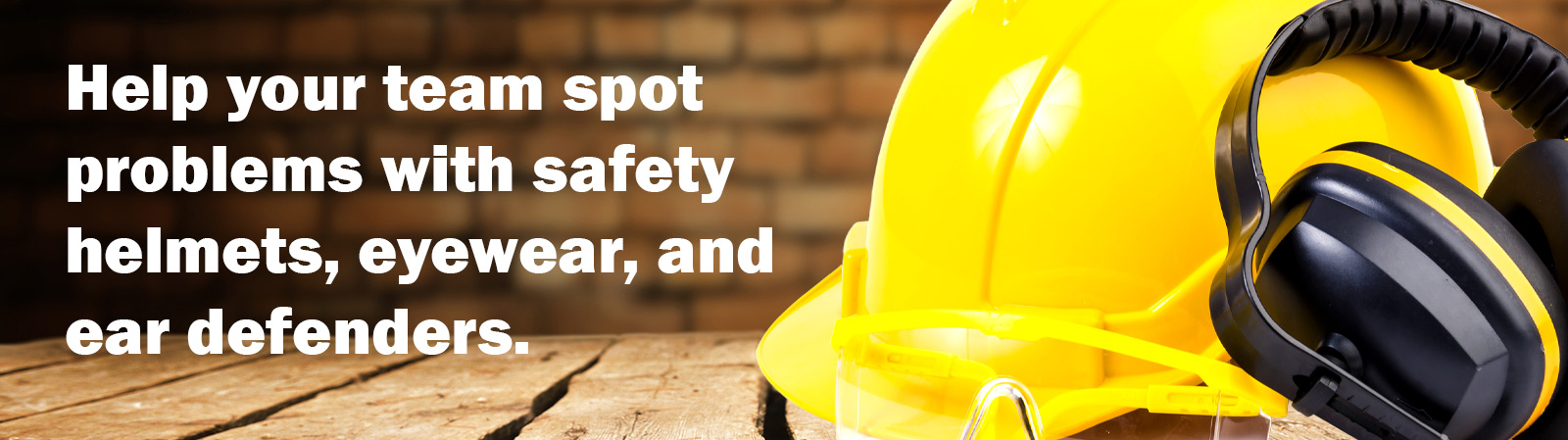
If you don’t look after your protective gear, it will let you down when you need it most. We’ve put together a quick guide to help you spot problems early and encourage your team check their equipment on a regular basis.
In this short post, we'll look at Safety Helmets, Safety Eyewear, and Ear Defenders.
Safety Helmets: How do I know if it's safe to use?
- Chin Strap (Optional but Required in Some Situations)
- Must be secure, adjustable, and undamaged.
- Buckles should snap firmly and stay fastened under stress.
- Inspect any fastening clips (chin strap, suspension clips) for damage or wear
- They should snap easily and securely and not slip under tension.
- Harness / Cradle
- UK helmets rely on a suspension system (internal webbing) to absorb impact.
- Check that straps are intact, not twisted or frayed, and that the crown strap supports the helmet evenly.
- The headband should be adjustable to fit different head sizes snugly.
- Rear Adjustment
- All (UK) Safety helmets have a Wheel Ratchet or Slip/Pin-lock adjustment at the back.
- Inspect for cracks, missing teeth on the ratchet, or loose pins.
- Helmet must stay firm on the head without sliding forward/backward.
- Lateral / Side Straps
- These are the internal suspension straps connecting the crown to the headband.
- Ensure they are intact, not twisted, and properly tensioned.
- Accessory Attachments
- If your helmet has visor, earmuff, or lamp mounts, check mounting points and straps.
- Ensure attachments don’t compromise the suspension system.
- Date
- Helmet manufacturing dates are typically found stamped inside the shell (often a moulded circle with an arrow for month and year) or on a sticker under the padding or on the strap.
- Manufacturers generally recommend replacing helmets every 3 to 5 years from the date of first use or 5 to 7 years from production due to material degradation.
Safety Eyewear: What do I need to look for?
- Scratched or clouded lenses:
Impairs vision and reduces impact resistance.
- Loose or bent frames:
Poor fit can leave gaps and compromise protection.
- Discoloured lenses:
Indicates chemical exposure or UV damage.
- Missing EN166 markings (Soon to be EN ISO 16321:2022): Click here for details.
Certification ensures the eyewear meets essential safety standards.
- Incorrect lens type for the task:
For example, standard impact lenses aren’t suitable for chemical splash protection.
Quick tip: Hold lenses up to a strong light source - scratches, pits, discolouring or haze will become obvious.
Ear Defenders: How do I check for signs of wear?
Signs they need attention:
- Visual and Tactile Inspection:
Run your fingers around the cushion to check for cracks, ensuring the surface is not cracked, hardened, or damaged. - Cracked or hardened cushions: Reduces seal and noise reduction.
- Loose or stretched headbands: Poor tension reduces effectiveness.
- Damaged adjustment mechanisms: Cannot achieve correct fit.
- Dirty or worn hygiene kits: Can cause skin irritation and reduce comfort, leading to improper use.
Also check for correct fit:
- Incorrect SNR rating for current environment: Even new ear defenders are ineffective if not suited to the noise level.
Finally: Try the quick "cupping" test
- Put on your ear defenders.
- Place your hands over both cups and press them firmly against your head.
- Results: If the noise around you (e.g., machinery, talking) drops significantly while you are pressing down, your current seal is poor, and the ear defenders are not working to their full potential. If the sound level stays roughly the same, the seal is working.
Even PPE that looks fine can have hidden defects. Regular checks, proper maintenance, and timely replacement can:
- Prevent injuries and downtime
- Ensure compliance with UK law
- Lowers cost and saves time
We are committed to encouraging safe working environments, and pride ourselves on delivering the highest level of service and quality possible.
