


 Log in to your portal
From anatomy to impact mechanics, and the surprising science of fluids that become solid under pressure
Safety Footwear Technical Review · May 2026
Every working day, thousands of workers walk job sites carrying loads that could permanently disable a foot in a fraction of a second. It's pretty much taken for granted that the toes are protected by a (steel or composite) toe cap, but the five long bones fanning back toward your ankle from your toes at the top of your foot, the metatarsals, have historically been far more vulnerable.
Modern metatarsal guards change that equation dramatically, and some of the most advanced versions do it using physics that sounds like something from a science fiction film: We're talking flexible materials that become as rigid as armour the instant an impact occurs.
The Anatomy of the Problem
The metatarsal bones span the middle part of the foot with only skin, tendon, and a thin layer of tissue between them and the outside world.
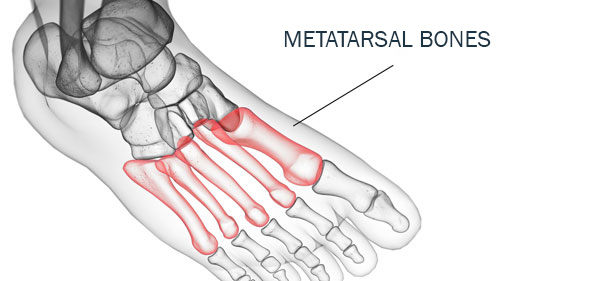
Figure 1 — The metatarsal bones span the middle of the foot, entirely outside the toe cap's protection zone
When something heavy falls across this area, the metatarsals can fracture under surprisingly modest forces. The top of the foot has almost no natural padding making it acutely vulnerable to crush injuries. UK Health and Safety Executive data consistently shows foot injuries accounting for roughly 5–7% of all workplace injuries requiring time off, with a significant proportion involving the midfoot.
A metatarsal fracture is not a minor injury. Depending on severity, recovery takes 6-12 weeks, and complications such as compartment syndrome, nerve damage, or poor healing alignment can result in permanent gait problems. In high-risk industries - construction, steel manufacturing, quarrying, logistics - metatarsal guards are not optional extras.
Types of Metatarsal Protection
There are two fundamental approaches to metatarsal protection.
External Guards
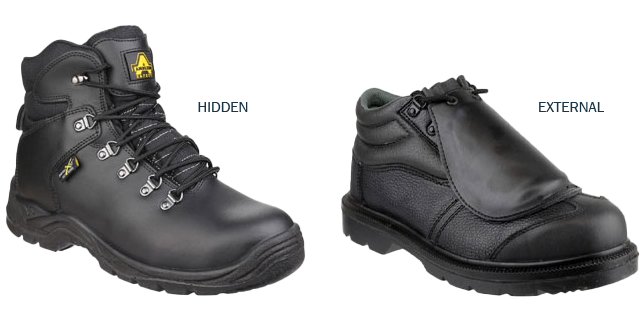
The traditional approach attaches a protective shell to the outside of the boot, over the tongue and lacing system. These external guards are typically made from reinforced nylon, polycarbonate composite, or aluminium alloy. They work by distributing the load of an impact across a wider surface area, preventing a concentrated force from reaching the underlying bones.
External guards offer an important practical advantage: they can be retrofitted to existing safety boots and removed when not needed. Workers in industries where metatarsal risk is intermittent - perhaps only when operating certain machinery - can add and remove them as circumstances change. However, they add bulk, can snag on machinery or structures, and are sometimes perceived as uncomfortable over long shifts.
Internal Guards
The more modern and increasingly preferred approach integrates the metatarsal protection directly into the boot's construction. Internal guards sit between the upper and the lining, invisible from the outside. They must achieve the same protective performance as external guards while being thin enough not to compromise wearability or significantly increase boot weight.
This is where materials science becomes critical, and where non-Newtonian fluids enter the picture.
Under EN ISO 20345:2022 (the European safety footwear standard), metatarsal protection is denoted by the letter M in the boot's classification. A boot marked S3 M HRO, for example, offers full safety toe, metatarsal protection, and heat-resistant outsole. The M classification requires the guard to withstand a 200-joule impact, equivalent to a 20kg mass falling from around one metre.
The Non-Newtonian Revolution
To understand why non-Newtonian materials are transformative for protective footwear, it helps to first understand what makes a fluid "Newtonian" in the first place.
Newtonian vs Non-Newtonian Fluids
Isaac Newton described the relationship between shear stress and the rate at which a fluid deforms (shear rate). For a Newtonian fluid this relationship is linear and constant. Viscosity doesn't change regardless of how fast you stir it or how hard you push through it. Water is just as easy to pour slowly as it is to pour quickly.
Non-Newtonian fluids break this rule. Their viscosity changes in response to applied stress or shear rate. There are several types, but the one that matters for protective equipment is the shear-thickening fluid, also called a dilatant fluid. These materials become dramatically more viscous, and can approach a near-solid state, when subjected to a rapid force.
"Hit it slowly and it flows around your finger. Punch it fast and it hits back - the fluid hardens against your fist in an instant."
The classic kitchen demonstration is cornstarch mixed with water (oobleck). Walk slowly across a tray of it and you sink. Run across and it supports your weight. The same principle, refined to an engineered material, is what sits between the layers of a modern metatarsal guard.
Particles suspended loosely. Material flows and conforms — flexible, comfortable to wear.
Particles jam and interlock in microseconds. Material becomes rigid, distributing force across the full panel.
The Particle Jamming Mechanism
The science behind shear thickening is now well understood, though it was a subject of significant research interest through the 1990s and 2000s. At the heart of it is a transition between two phases of particulate organisation.
- 1Suspension state: Engineered STF materials use hard particles, typically fumed silica nanoparticles or similar suspended in a carrier fluid (commonly polyethylene glycol). At rest or under slow deformation, the particles are well-separated by the fluid layer around each one, allowing them to flow past each other freely.
- 2Hydrocluster formation: When shear rate increases rapidly (as during an impact) the drag forces between particles overwhelm the stabilising forces of the fluid. Particles are pushed together faster than they can flow apart. They begin to form temporary clusters, called hydroclusters.
- 3Jamming transition: As more and more hydroclusters form and connect, the material undergoes what physicists call a jamming transition: The network of particle contacts becomes load-bearing across the entire material. In microseconds, the fluid has become effectively solid.
- 4Force distribution: This instantaneous rigidity means the guard panel now acts as a plate, spreading the impact force across its entire surface area rather than allowing it to concentrate on a small point. The metatarsal bones beneath experience a fraction of the localised pressure.
- 5Recovery: When the impact passes, the hydroclusters dissolve and the material returns to its flexible fluid state. The process is entirely reversible.
A steel or hard composite plate distributes force well, but it does so all the time, making the boot stiff and fatiguing to wear. An STF panel is flexible during normal walking (absorbing very little energy, offering no resistance), then stiff precisely when it needs to be. The material self-activates based on the physics of the event itself, with no sensors, actuators, or moving parts.
Engineering STF Into a Boot
Taking the science from a laboratory demonstration to a product that survives a decade of industrial use involves several engineering challenges that the original physics didn't address.
Containment and Durability
The STF material must be sealed within a flexible membrane that itself can withstand repeated impact, flexion across many thousands of steps, temperature extremes (from freezer warehouses to foundry floors), and exposure to the chemicals commonly found in industrial environments. Polyurethane films and laminated non-woven textiles are commonly used. The stitching or bonding of these membranes is critical, a failure here allows the suspension to migrate or leak, degrading performance over time.
Thickness and Weight Optimisation
Internal guards must be thin. A panel that adds 8mm to the profile of a boot makes it unwearable for many applications and adds meaningful weight. Research has focused on maximising the particle concentration of the suspension, thicker suspensions achieve the jamming transition at lower shear rates and with thinner layers. The trade-off is that very high concentration suspensions can begin to show shear thickening even at walking speeds, which reintroduces stiffness during normal use.
Hybrid Architectures
Many commercial metatarsal guards combine STF material with structural components. A thin rigid spine or a flexible composite shell may sit beneath the STF layer, providing a secondary distribution mechanism. The STF handles the rapid initial response and manages localised force concentrations; the structural backing handles the overall bending load. Together, they outperform either approach in isolation.
Temperature Behaviour
Viscosity in fluid systems is strongly temperature-dependent. An STF formulated for optimal performance at 20°C may behave very differently at -20°C (a freezer environment) or at 80°C (near certain industrial processes). Manufacturers working across these ranges must either formulate separate products or use additives that flatten the viscosity-temperature curve. This remains one of the more technically demanding aspects of STF boot development.
Standards and Testing
Regardless of the technology used internally, metatarsal guards sold in the UK and Europe must meet the same performance requirements.
Primary European safety footwear standard. Metatarsal protection is classified under Annex A with the M designation.
The guard must survive a 200-joule impact without allowing the striker to contact the foot form beneath.
Some specifications add a compression resistance requirement, testing sustained crush loads in addition to dynamic impact.
Chemical splash resistance and other supplementary certifications relevant to specific industry applications.
| Guard type | Weight penalty | Flexibility | Best applications |
|---|---|---|---|
| External aluminium shell | Medium–high | None (rigid) | Steel, quarrying, heavy manufacturing |
| External composite shell | Low–medium | None (rigid) | General construction, utilities |
| Internal rigid composite | Low | Some (panel flex) | Logistics, warehousing, manufacturing |
| Internal STF panel | Very low | High (fluid at rest) | All-day wear, mixed-risk environments, precision work |
| Hybrid STF + composite | Low | Medium–high | High-risk industrial, long shift wear |
The Practical Picture
The strongest argument for non-Newtonian metatarsal guards is a simple one: they overcome compliance problems. Traditional rigid guards protect effectively but workers find them uncomfortable, and uncomfortable PPE is PPE that gets removed, modified, or simply not worn. Industry research and health and safety professionals consistently identify non-compliance as a greater risk than inadequate product specification.
A boot with an integrated STF metatarsal panel feels, to the wearer, like a boot without any guard at all during normal movement. There is no stiffness penalty across the midfoot during walking. Workers who previously resisted wearing metatarsal protection report significantly better acceptance of STF-equipped boots.
The technology has matured considerably since its initial commercialisation in the late 2000s. Early products occasionally showed premature degradation of the suspension or inconsistent shear thickening behaviour across their service life. Current generation materials use more robust particle chemistries, better membrane systems, and more precisely controlled particle size distributions. Leading manufacturers now publish service life data supporting use for two or more years under typical industrial conditions.
For procurement teams specifying protective footwear for high-risk sites, the practical takeaway is straightforward: the certification label matters (look for the M designation under EN ISO 20345), but so does wearing comfort over a full shift. A metatarsal guard that stays on a worker's foot all day, every day, will always outperform a technically superior guard that gets left in the locker.
Metatarsal guards protect the five long bones spanning the top of the foot — a region a standard toe cap cannot reach. Modern internal guards increasingly use shear-thickening fluid (STF) technology: a suspension of hard particles that remains flexible during walking but jams into a rigid load-distributing solid within microseconds of impact. The physics — hydrocluster formation and the jamming transition — is the same phenomenon seen in cornstarch and water, applied to engineered nanomaterials. The result is a guard that meets the 200-joule requirement of EN ISO 20345 without the stiffness penalty that previously drove worker non-compliance.
