


 Log in to your portal

PK Safety Protective Equipment · UK & Europe
Understanding EN388: The UK & European Standard for Protective Gloves
Your hands are involved in virtually every task you perform at work. Understanding how glove protection is measured and rated is essential for both employers and employees across the UK and Europe.
Mechanical risks are the most common hand hazard in UK workplaces - covering anything that can cause injury through a physical or mechanical action. These are typically grouped into five categories: abrasion, cut, tear, puncture, and impact.
When sourcing gloves, the clearest indicator of suitability is the safety certification standard. For mechanical risks in the UK and EU, the relevant standard is:
BS EN 388:2016+A1:2018
Protective gloves against mechanical risks - published by the British Standards Institution (BSI) and adopted across the EU
Following Brexit, the UK retained EN 388 as its domestic standard via the BSI. Gloves sold in Great Britain continue to display UKCA marking alongside (or instead of) CE marking for EU markets. The standard itself - and its test methodology - is identical in both cases.
The six performance tests
Each certified glove receives a rating code derived from up to six individual tests. Here is what each test measures:
Martindale Abrasion Test - Abrasion resistance
Rates resistance to surface wear caused by rubbing. Scored 1-4, with 4 offering the highest protection.
Coupe Cut Test - Blade cut resistance
Measures resistance to a rotating blade under constant load. Rated 1–5, but if the blade dulls before the test completes, the glove is awarded an "X". In practice, this usually happens around level 3, making X a common result for high-performance cut-resistant gloves - it is not a failure.
Tensile Test - Tear resistance
Assesses how well the glove material resists tearing apart. Rated 1-4.
Compression Test - Puncture resistance
Tests resistance to penetration by a pointed object under increasing pressure. Rated 1-4.
ISO Cut Test (TDM-100) - Cut resistance by force
A separate cut test introduced in the 2016 revision that measures the force needed to cut through the material. Rated A–F, with F offering the greatest cut protection. This test is especially important for gloves that scored an "X" on the Coupe test.
Domed Anvil Impact Test - Impact protection (optional)
An optional test for gloves designed to protect against impact. Result is either P (pass) or omitted if not tested. Impact protection is particularly relevant in construction, mining, and heavy industrial settings.
Reading the rating code
The results of all tests are combined into a single rating code printed on the glove label - typically beneath the EN388 pictogram (see example below).
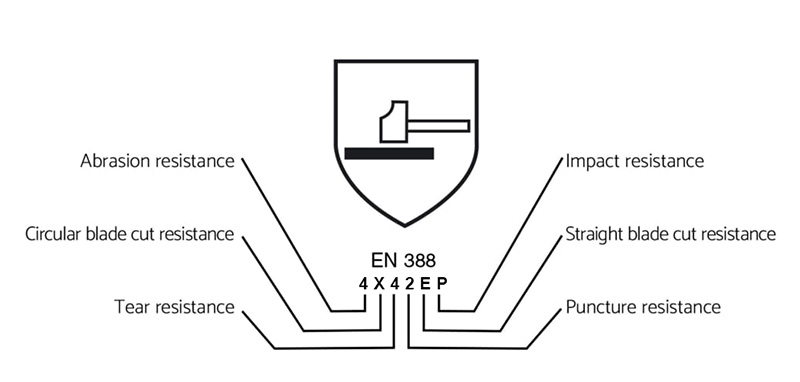
An "X" in the Coupe position is not a defect - it means the blade dulled during testing, which typically happens on high-performance cut-resistant materials. For these gloves, look to the ISO Cut letter (position 5) for the true measure of cut protection.
Not all of the six positions will appear at all times. The impact test is optional, and older certified gloves may only show four positions (the pre-2016 format). When assessing gloves for your team, check which positions are present and whether a sixth position is relevant to your specific hazard.
UK & EU compliance: UKCA and CE marking
Since 1 January 2021, gloves sold in Great Britain must carry UKCA marking to indicate conformity with UK regulations. CE marking remains valid for the EU market. Many manufacturers apply both marks. The underlying EN 388 standard is harmonised, so the ratings mean the same thing regardless of which mark appears on the glove.
Under the UK PPE Regulations 2002 (as retained in UK law) and EU PPE Regulation (EU) 2016/425, employers have a legal duty to ensure that any protective gloves provided to workers are appropriate for the risks present and certified to a recognised standard. EN 388 fulfils this requirement for mechanical risks.
Need help choosing the right gloves for your workplace?
