


 Log in to your portal
A simple guide to EN ISO 20345:2022
Getting to grips with safety standards can be challenging. Even for experienced industry professionals, navigating the wide array of specifications and requirements can rapidly become overwhelming.
The change in the EN standard for safety footwear now threatens to create further confusion for health & safety managers. This guide from PK Safety is designed to demystify the new standard. It provides a straightforward overview of everything you need to know about EN ISO 20345:2022
and what – if anything – you need to do now.
Navigating the transition: EN ISO 20345:2011 to EN ISO 20345:2022
The launch of the new standard EN ISO 20345:2022 for safety footwear, which took place in March 2023, introduces enhanced safety specifications for occupational footwear. For manufacturers, the ability to continue production under valid EN ISO 20345:2011 certificates until November 11th, 2024 provides a transitional period. After this date, it’s important to note, that all existing certificates will expire at their designated date, at which time, safety footwear must be re-tested and certified against the updated requirements of EN ISO 20345:2022.
This transition period, extending up to five years, allows for a gradual integration of the new standard. Customers can therefore expect to encounter safety footwear certified under either the 2011 or 2022 standard until November 2029. Understanding these timelines allows both manufacturers and customers to navigate the shift effectively.
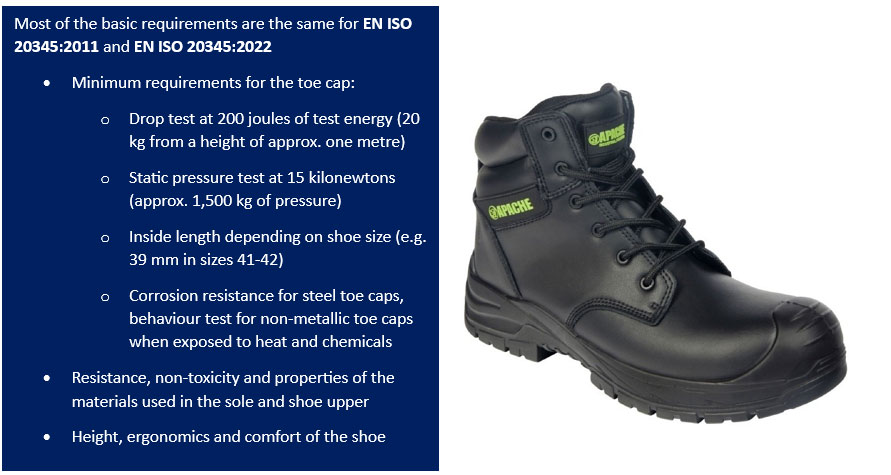
EN ISO 20345:2022 includes several key changes to help health & safety professionals ensure they are purchasing the products they need.
Slip resistance
The most significant change is that slip resistance has been added as a basic requirement for all safety footwear classes. Under the 2011 standard, footwear was marked 'SRA' if it passed a slip resistance test on ceramic tiles with a sodium lauryl sulphate solution. Similarly, 'SRB' marked footwear passed a test on steel surfaces with glycerol. Shoes or boots that excelled in both tests received the 'SRC' designation. All tests (SRA, SRB, and SRC) evaluated slip resistance in two modes: heel slip and flat surface walking.
Under EN ISO 20345:2022
, the ‘SRA’, ‘SRB’ and ‘SRC’ markings are no longer used. Instead, all appropriate safety shoes must demonstrate basic slip resistance by undergoing a test similar to the previous SRA certification on ceramic tiles. Safety footwear can be marked ‘SR’ if they also pass a slip test on a ceramic tile with glycerol. Products with this marking therefore replace those that had a ‘SRC’ certification under the 2011 standard.
The slip resistance testing procedure has also been improved. Previously, slip resistance could be checked against any part of the sole. Now it must be tested specifically on the heel (heel strike area) and at the toes (push-off point), the two critical contact points where there is minimal contact with the ground. These areas play a crucial role in weight-bearing, distribution, stability and the overall mechanics of walking.
If the slip resistance test cannot be carried out, such as in shoes with metal spikes, the symbol ‘Ø’ is used.
Beyond the basic requirements
There are now 18 potential additional requirements, which are as follows:
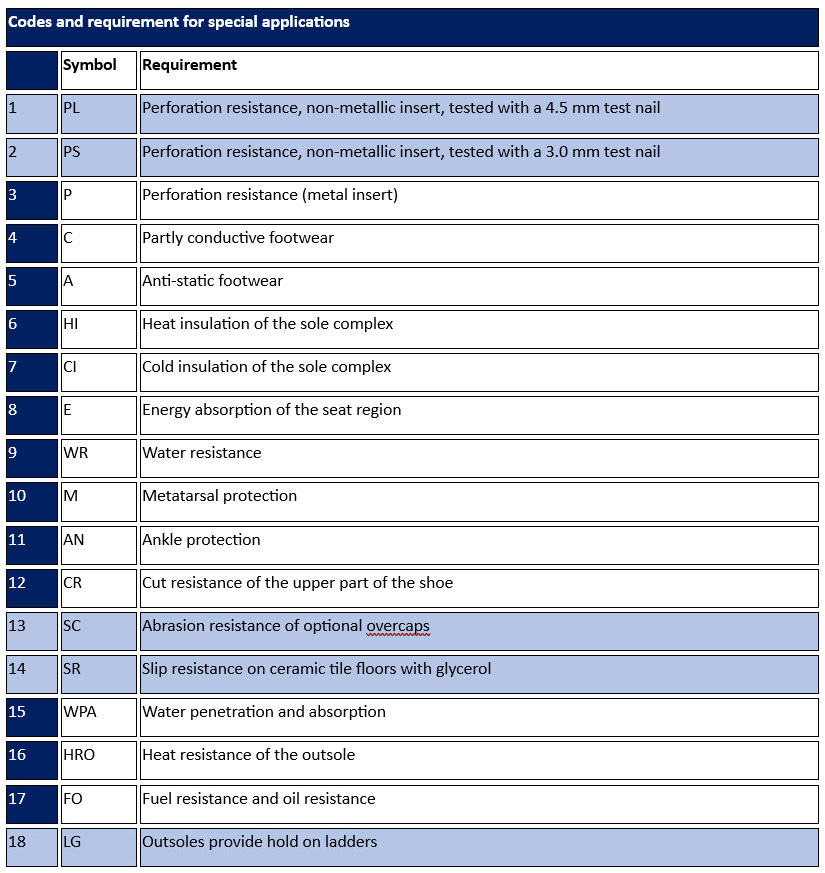
Key changes:
- Perforation resistance: Under the old standard, all safety shoes or boots that offered protection against nail penetration had the marking ‘P’. Under the new standard, ‘P’ is used for metallic soles that have been tested with a 4.5 mm nail. Shoes with non-metallic soles are marked with either ‘PL’ if tested with a 4.5 mm nail or ‘PS’ if tested with a 3 mm nail. As smaller diameter nails give a higher pressure, ‘PS’ offers a higher level of protection.
- Ladder grip: The outsole of all safety footwear must have a transverse profile with a height of at least 1.5 mm in the ankle area to provide adequate grip on ladders. Previously, this was included in the standard for footwear intended for firefighters. Now, this has been copied for a standalone additional test for all safety shoes or boots and is signalled with an ‘LG’ marking.
- Fuel oil resistance: The previous standard mandated that all safety footwear other than those with an open heel (SB) offered resistance to fuel oil. The new standard includes resistance to hydrocarbons – indicated by an ‘FO’ marking – as an additional test for environments in which hazards such as oil and petrol are present.
- Scuff cap: An ‘SC’ marking can be used if an over-cap does not develop any holes across its entire thickness when subjected to a Martindale abrasion test of 8,000 cycles.
- Water resistance: The EN ISO 20345:2011
Standard featured ‘WRU’ markings for shoes/boots with ‘water-resistant uppers. However, this did not indicate that the footwear was waterproof as the test requirement is, that no more than 3cm$^{2}$ of water penetration is allowed. This is because only the upper itself was tested to obtain WRU certification; when the upper is included in a shoe, the shoe as a whole can lose its water-repellent ability because water penetrates into the seams.
Under the new 2022 standard, WRU has been replaced by WPA. ‘WPA’ now indicates that footwear can allow for some ‘water penetration and absorption’. WPA footwear offers some breathability and can be used in working conditions that do not require the feet to be submerged in water. Also, under the new 2022 standard the ‘WR’ (water resistant) marking is the same test for water penetration that is used during the 2011 test, but it is the result that differs. In order to be marked as ‘WR’ the 2022 standard states no water penetration inside the footwear shall be detected where, as above, the 2011 test allows for 3cm cubed of water to penetrate the footwear and therefore, the new WR standard is more stringent.
To help equate one standard to another, a previous S2 model with WR has now become an S6, and a previous S3 model with WR has become an S7. Often a membrane is used to achieve this however, footwear without a membrane could pass the water resistance testing but the seams would need to be very watertight. The test itself is referred to as “water resistance” and not waterproof, a term often used by wearers. The term “waterproof” would insinuate that the footwear would never allow water to enter, which over time cannot be guaranteed by any manufacturer due to use, wear and tear, also via the tongue and seams of the footwear, depending on depth of water submersion.
Understanding the new protection levels
Under the 2011 standard, the protection levels were divided into six classes: SB, S1, S2, S3, S4 and S5. Under the new standard, there are now eight main protection classes: SB, S1, S2, S3, S4, S5, S6 and S7.
The two new protection classes – S6 and S7 – are used to indicate those with higher water resistance properties in line with the new ‘WR’ certification (see above section on water resistance). In addition to the new classes, the class codes may also be followed by ‘P’, ‘L’ (or ‘PL’) and ‘S’ (or ‘PS’) to indicate additional perforation resistance in line with the ‘P’, ‘PL’ and ‘PS’ certifications.
Using the chart below, you can identify the protection level you require based on your specific workplace risk requirements.
Why was the new standard introduced?
There is no question EN ISO 20345:2022
will make procurement more challenging in the short-term. Nonetheless, the red tape serves a purpose. UK and EU standards are exceptionally high to ensure workers have access to the safety equipment they need to keep injuries and fatalities to a minimum.
In addition to ensuring basic slip resistance in every safety shoe/boot, the new ladder grip certification will be vitally important for many workers. Falls from height are among the most common cause of injuries and fatalities. The new ‘LG’ markings provide workers with reassurance that their footwear has passed specific tests to ensure the outsoles provide hold on ladders.
The new perforation resistance codes also explicitly state whether soles are metallic or non-metallic, which provides buyers with greater clarity on product selection.
There are now distinctions in the standards between metallic or non-metallic toecaps as well. For example, the flange width for metallic toecaps must be below 12 mm and for non-metallic toecaps it must be 15 mm. These distinctions will mean if a buyer purchases the same product from multiple factories, they no longer risk receiving some with metallic toecaps and some with composite toecaps.
What does the new standard mean for you?
The good news is that – for most health & safety professionals – the new standard will not require any immediate action. During the transition period, you will be permitted to buy safety footwear that conforms to either the old or the new standard. If you purchase your safety shoes from a reliable manufacturer, they should deliver the same level of protection as those produced according to the new standard. The basic requirements remain largely unchanged and there is no need to replace footwear that is already performing successfully.
You should aim to buy shoes/boots that meet the new standard if:
- Workers have suffered accidents caused by their footwear, such as slips and falls
- You carry out a new risk assessment and identify new workplace hazards
- The footwear is subject to wear and tear that affects their protective features
If you have any further questions regarding EN ISO 20345:2022, please do not hesitate to contact us.
