


 Log in to your portal
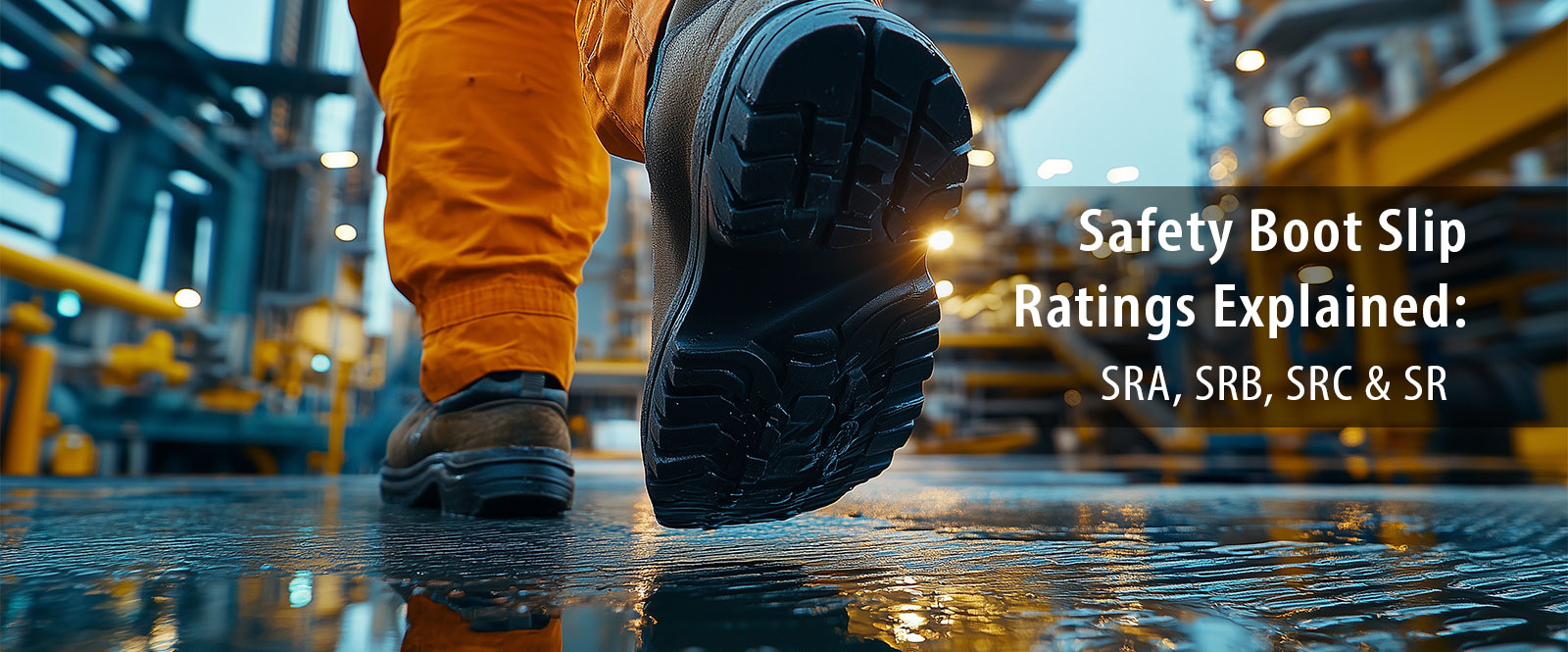
Safety Boot Slip Ratings Explained: SRA, SRB, SRC and SR
Slip-resistance markings can help organisations select safety footwear appropriate to their working environment. This guide explains what SRA, SRB, SRC and SR mean, how the standards have changed, and how to assess footwear beyond the rating alone.
At a glance
- SRA, SRB and SRC are older slip-resistance classifications.
- SR is an additional slip-resistance marking under EN ISO 20345:2022.
- No rating guarantees slip-proof footwear. Performance depends on the floor surface, contaminants and working conditions.
- Footwear selection should be based on the workplace risk assessment, not the slip marking alone.
Why slip ratings matter
Wet warehouse floors, grease near machinery, rainwater tracked into workshops and spills in production areas are common workplace hazards. Where footwear does not provide suitable grip, these conditions can quickly contribute to slips, trips and falls.
Selecting safety boots involves more than choosing an appropriate toecap or comfortable fit. The outsole plays a central role in maintaining stability, particularly on wet, smooth or contaminated surfaces.
Slip-resistance markings, such as SRA, SRB, SRC and SR, indicate how footwear has performed under defined test conditions. They provide valuable information, but they do not remove the need to assess the specific hazards present in the workplace.
What are safety boot slip ratings?
Safety footwear is tested against recognised standards to assess its protective performance. In the UK, EN ISO 20345 is the principal standard for safety footwear incorporating protective toecaps.
The slip-resistance markings applied to footwear depend on the version of the standard against which the product was certified. Older footwear may carry SRA, SRB or SRC markings, while footwear certified to EN ISO 20345:2022 may carry the additional SR marking.
SRA
Test condition: ceramic tile with a dilute soap solution.
SRA is an older classification. It indicates that footwear passed a test on wet ceramic tiles, but it does not establish performance on oily concrete, muddy ground or other workplace surfaces.
SRB
Test condition: smooth steel with glycerol.
SRB is also an older classification. It assessed footwear under a different set of conditions, but real workplaces may involve a wider range of oils, fluids, surface finishes and contaminants.
SRC
Test condition: passed both SRA and SRB tests.
SRC indicates that footwear met the requirements of both earlier test methods. It does not mean the boot is suitable for every slippery surface or contaminant.
SR
Test condition: ceramic tile with glycerol under EN ISO 20345:2022.
SR is an additional slip-resistance marking under the newer standard. Basic slip resistance is now a requirement, while SR identifies footwear that has also passed the additional test.
SRA, SRB, SRC and SR at a glance
| Marking | Test condition | What to remember |
|---|---|---|
| SRA | Ceramic tile with dilute soap solution | Older test classification |
| SRB | Smooth steel with glycerol | Older test classification |
| SRC | Passed both SRA and SRB tests | Combined older test classification |
| SR | Additional test on ceramic tile with glycerol under EN ISO 20345:2022 | Additional slip-resistance marking under the newer standard |
Slip ratings in real-world environments
Laboratory testing provides a useful starting point, but the working environment ultimately determines which footwear is appropriate. The following scenarios illustrate how different conditions can affect footwear selection.
1. Warehousing and logistics
Warehouse personnel may spend substantial portions of their shifts walking across concrete floors, moving between racking aisles, loading bays and vehicle access points.
Rainwater can be transferred indoors on footwear or enter through open loading doors. Dust, packaging debris and occasional fluid spills may introduce further slip hazards.
Key considerations:
- The condition and finish of the concrete floor surface.
- The frequency and location of wet areas, particularly near entrances and loading bays.
- The types of spills or contaminants likely to be present.
- Outsole performance during prolonged periods of walking and standing.
A slip-resistance marking provides useful guidance, but sole design, material composition and suitability for the specific floor environment remain critical considerations.
2. Commercial kitchens and food production
Commercial kitchens and food-production facilities can present particularly demanding conditions for safety footwear.
Water, cleaning solutions, cooking oils and food residues may all be present on floor surfaces. Certain substances can also accumulate within the tread pattern, reducing effective contact between the outsole and the floor.
Key considerations:
- Footwear selection based on the conditions identified in the workplace risk assessment.
- The outsole pattern, as well as its tested performance.
- Whether the tread design allows contaminants to clear effectively.
- Supplier test data relevant to the actual surfaces and substances present.
Where slip risks are significant, a tread design that facilitates contaminant clearance may offer greater practical value than one that becomes readily obstructed by food waste.
3. Construction and outdoor trades
Construction and outdoor trades present a distinct set of operational challenges. Mud, loose gravel, wet paving, uneven terrain and changing weather conditions can all affect stability.
Footwear that performs effectively on a smooth indoor surface may not deliver comparable performance on loose or muddy ground.
Key considerations:
- The suitability of the tread pattern for the expected terrain.
- The outsole’s ability to shed mud and debris.
- Additional required protection, such as resistance to penetration by sharp objects.
- Waterproofing, durability and wearer comfort.
A deep tread may be beneficial in certain outdoor conditions; however, tread depth alone does not determine slip resistance. Overall outsole design and material composition are equally important.
4. Manufacturing and engineering
Manufacturing environments may involve smooth concrete, metal walkways, machinery and substances such as lubricants or cutting fluids.
Different contaminants can affect grip in different ways. Footwear that performs well under one wet-surface test may not provide equivalent performance when exposed to a specific industrial oil or fluid.
Key considerations:
- The substances workers are likely to encounter.
- Whether standard test conditions adequately reflect those risks.
- The suitability of the outsole material and tread design.
- The value of additional testing or workplace trials.
Where appropriate, footwear suppliers should be asked to provide additional testing or trials under representative operational conditions.
Five things a slip rating doesn’t tell you
Slip ratings provide a useful indication of performance, but they should not be viewed in isolation. The following considerations support a more informed footwear-selection process.
1. Oil resistance does not automatically indicate slip resistance
Oil resistance generally refers to the sole material’s ability to withstand the effects of oil exposure. It does not, in itself, guarantee adequate grip on an oil-contaminated surface.
Where oil is a regular workplace hazard, footwear should be assessed against the specific operational conditions rather than selected solely on the basis of an oil-resistance claim.
2. No slip rating makes footwear slip-proof
Standardised tests assess performance under defined conditions. Real-world workplaces involve varied surfaces, contaminants, gradients and environmental factors.
Even footwear that has passed the relevant tests may not perform as intended when used outside the conditions for which it has been specified.
3. A deeper tread is not always preferable
A pronounced tread pattern can be beneficial on loose or uneven outdoor surfaces. However, tread performance varies according to both the floor surface and the contaminant present.
Sole material and tread geometry both influence grip. Some indoor environments may benefit from a more closely spaced tread pattern, while other conditions may require a more open design.
The most appropriate option should be determined by the specific work activity and working environment.
4. A safety rating does not address every workplace hazard
Slip resistance represents only one element of a safety boot’s overall specification.
Depending on the role and environment, additional protection may be required, including toe protection, penetration resistance, water resistance, heat resistance or other task-specific features.
The complete footwear specification should always be reviewed against the findings of the workplace risk assessment.
5. Worn soles can compromise performance
Even appropriately specified footwear can become less effective over time as it wears.
Flattened tread, damaged outsole material and debris lodged within the sole can all reduce grip. Regular inspection and timely replacement are essential components of an effective protective-footwear programme.
How to choose the right safety boots
When purchasing footwear for an individual or specifying it for a team, the decision should extend beyond the slip rating alone. The following framework provides a structured approach.
- Identify the principal slip hazards. Consider where workers walk and what they encounter. Determine whether floors are generally dry, regularly wet, contaminated with oil, or affected by mud and debris.
- Review the footwear standard. Examine the marking and certification information to establish which standard the footwear meets. Remember that SRA, SRB and SRC relate to a previous version of the standard.
- Match the outsole to the environment. Assess sole material, tread pattern, durability and suitability for the surfaces involved. Avoid selecting footwear solely on the basis of tread appearance.
- Confirm wider protection requirements. Ensure the footwear provides the protection required for the role, including toe protection, penetration resistance and weather protection where necessary.
- Consider a workplace trial. Where slip risks are significant, a trial can help establish practical performance. Involve workers who represent the relevant roles and conditions, and assess comfort and usability as well as grip.
- Maintain footwear throughout its service life. Establish a routine for inspecting soles, removing debris and replacing footwear when its condition or protective performance deteriorates.
Practical recommendation: Use the workplace risk assessment as the starting point, then use slip ratings, product specifications, supplier guidance and workplace trials to validate the final selection.
Frequently asked questions
Are SRC safety boots better than SR safety boots?
No, not necessarily. SRC and SR belong to different versions of the footwear standard and use different test arrangements. They should not be compared as though one is automatically superior. Review the certification standard, full product specification and suitability for the working environment.
What is the difference between SRA and SR?
SRA is an older classification based on testing on ceramic tile with a dilute soap solution. SR is an additional slip-resistance marking under EN ISO 20345:2022, based on a test using ceramic tile with glycerol.
Are SR-rated boots suitable for oily floors?
Not automatically. The SR test does not establish performance against every type of oil or industrial contaminant. Where oily floors are a regular hazard, footwear advice should be based on the specific conditions.
Should older SRC-rated safety boots be replaced?
Not simply because the marking is older. Footwear should be reviewed to confirm that it remains suitable for the work, meets applicable requirements and remains in good condition.
How often should safety boots be replaced?
There is no universal replacement interval. Footwear should be inspected regularly and replaced when the outsole is worn or damaged, or when a protective feature is no longer fit for purpose.
Find the right safety boots for your workplace
Choosing suitable safety footwear begins with understanding the hazards workers face each day. Slip-resistance markings provide valuable information, but they represent only one part of the decision.
The most appropriate footwear combines tested slip performance with a suitable outsole design, the protection required for the role and a comfortable fit that can be worn throughout the working shift.
Explore our range of safety boots and slip-resistant footwear, or contact our team for advice on selecting footwear suited to your workplace.
For further guidance, consult the Health and Safety Executive’s advice on selecting slip-resistant footwear. Always assess footwear against the specific risks and conditions present in your workplace.
