


 Log in to your portal
How to Read EN Safety Ratings (Without a Standards Handbook)
If you've ever picked up a hard hat, a pair of work gloves, a bike helmet, or even a stepladder, you've probably seen a little label with "EN" followed by a number. That code is actually a compressed summary of exactly what the product was tested for and how well it performed.
What "EN" Actually Means
EN stands for European Norm: A technical standard published by European standards bodies (CEN or CENELEC) and adopted across EU and EEA countries. Each EN standard covers one specific product category or hazard type, and defines:
- What the product must be tested against (impact, flame, chemical exposure, load, etc.)
- The test method itself
- The performance levels or "classes" a product can achieve
- What markings must appear on the product or packaging
The number after "EN" isn't arbitrary, it's a reference to a specific published standard, similar to how ISO numbers work. EN 397, for example, is a completely different document from EN 388, covering a different product entirely.
Understanding EN Numbers
Each EN standard relates to a specific type of PPE. For example:
| PPE | Common Standard | Covers |
|---|---|---|
| Safety Gloves | EN 388 | Mechanical risks |
| Cut Resistant Gloves | EN ISO 13997 | High-level cut testing |
| Disposable Gloves | EN ISO 374 | Chemical and microorganism protection |
| Safety Footwear | EN ISO 20345 | Protective footwear |
| Safety Helmets | EN 397 | Industrial safety helmets |
| Safety Glasses | EN 166 | Eye protection |
| High Visibility Clothing | EN ISO 20471 | Visibility requirements |
| Hearing Protection | EN 352 | Ear defenders and ear plugs |
The number itself doesn't indicate how protective a product is, but simply identifies the testing standard. Two gloves can both carry the EN 388 mark and still perform very differently, because the number only tells you which test was applied, not how well the product scored.
To work out how well a product scored for a particular test, we need a second set of numbers that we can look at below.
The Basic Anatomy of a Rating
Most EN ratings follow a pattern like this:
EN [standard number]:[year] - [class/level codes]
For example: EN 397:2012, or EN 388:2016 (4X43D).
- The number tells you which standard applies (i.e., what was tested).
- The trailing letters/digits are performance classes for specific hazards within that standard. This is the part most people skip over, and it's usually the most useful part.
- The year matters: Standards get revised, and a 2016 test isn't always equivalent to a 2003 one under the same number.
Common EN Examples You'll Actually Encounter
Head Protection: EN 397 / EN 12492
Industrial hard hats (EN 397) are tested for impact absorption, penetration resistance, and flame resistance. Optional markings you might see added on:
- LD – lateral deformation resistance
- MM – molten metal splash resistance
- 440V AC – electrical insulation rating
Climbing helmets fall under EN 12492 instead, which has different impact zones and lighter shell requirements, so a hard hat and a climbing helmet aren't interchangeable even though both protect your head.
Hand Protection: EN 388
This is one of the most misread labels around. EN 388 gloves show a string of numbers/letters like 4X43D, each digit representing a separate test:
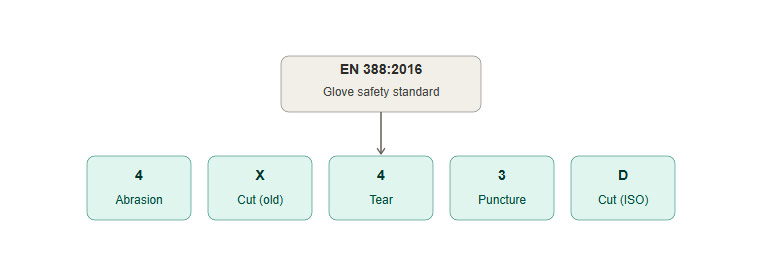
- Abrasion resistance (1-4)
- Blade cut resistance, old method (1-5, "X" = not tested)
- Tear resistance (1-4)
- Puncture resistance (1-4)
- A letter (A-F) for cut resistance under the newer ISO 13997 method
Higher numbers/letters = better performance in that specific category - but a glove can be great at abrasion and poor at puncture, so check each digit, not just the first one.
Eye Protection: EN 166
Covers impact resistance, optical class, and specific hazard resistance (e.g., "3" for liquid droplets, "9" for molten metal). A "1" optical class means suitable for extended wear; "3" is for occasional/short-term use only.
Ladders and Steps: EN 131
Defines duty rating, load class, and structural test requirements. Unlike some older regional standards, EN 131 doesn't publish a simple "Type 1/1A" duty rating - instead products are tested against defined load and stability criteria, so check the manufacturer's stated safe working load alongside the EN 131 mark.
Glass and Glazing: EN 12600
Rated using a pendulum impact test, expressed as three characters (e.g., 1B1):
- First digit: impact class (1 = highest energy tested, 3 = lowest)
- Letter: breakage mode (A = sharp shards, B = cracks but stays intact-ish, C = small blunt particles)
- Last digit: drop height class used
Three Things Worth Remembering
A higher number after "EN" doesn't mean "safer." EN 397 isn't a better version of EN 166, they're unrelated standards for unrelated hazards. It's important to compare products within the same standard, not across different ones.
The suffix classes matter more than the base number. Two products can both say "EN 388" and perform very differently depending on the digits that follow.
CE marking and EN compliance aren't the same thing. CE marking is a manufacturer's declaration of conformity with EU regulations broadly; an EN number tells you which specific test standard was used to support that declaration. Look for both, but don't assume one implies the other automatically.
The Quick Way to Check a Rating
If you're standing in a shop or reading a spec sheet and see an EN code you don't recognise, the fastest way to interpret it is:
- Note the standard number and year.
- Search "[EN number] performance levels" to find what each class digit represents.
- Compare only within that same standard when judging "better vs. worse."
Once you know the pattern, EN labels stop being a wall of random characters and start being one of the most useful pieces of information on the packaging.
